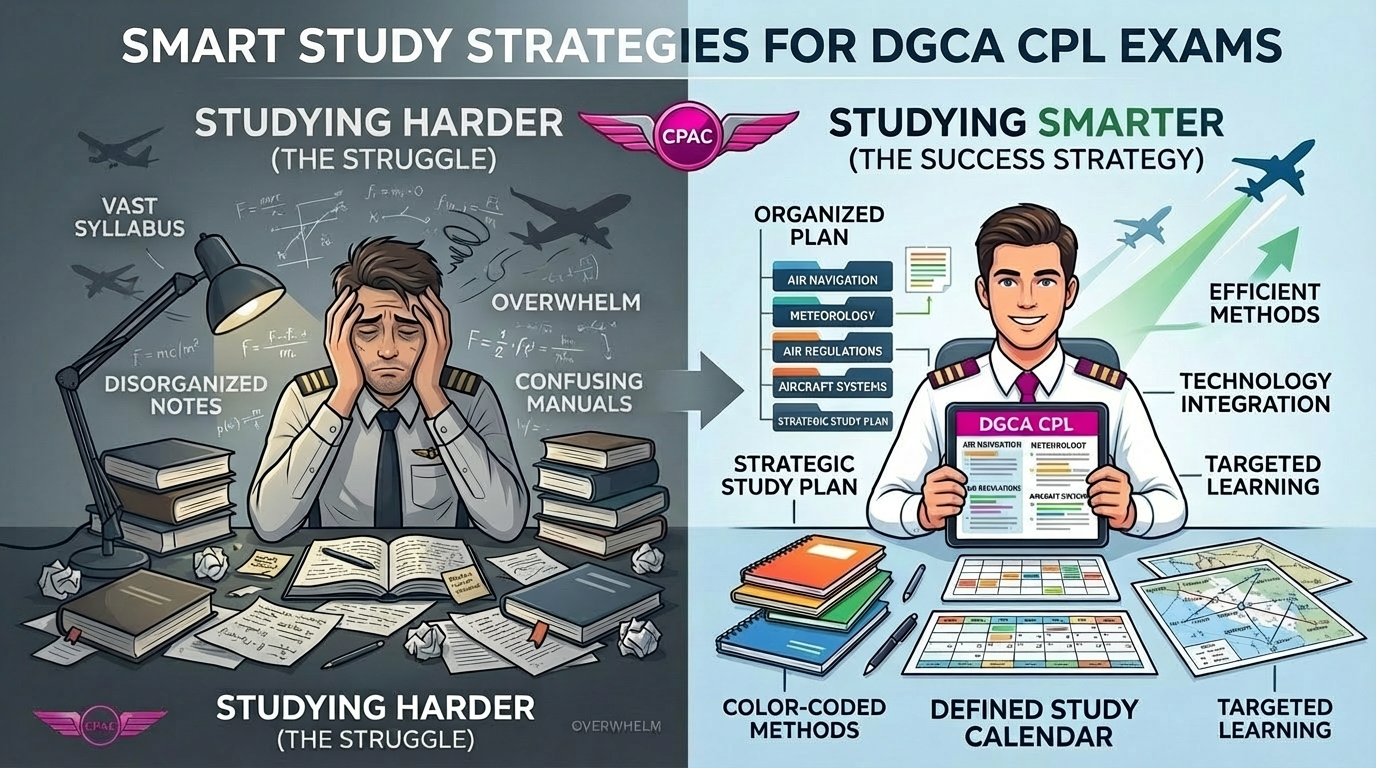
First, Let's Be Honest About Something
Nobody becomes a commercial pilot by accident. And nobody fails the DGCA CPL exams because they weren't intelligent enough.
Students fail when they prepare without a strategy. They study one subject endlessly while ignoring another. They memorise question banks without understanding concepts. They skip mock tests. They treat Technical General as an afterthought. And then they walk into the exam hall — and the paper looks nothing like what they memorised.
Sound familiar? You're not alone.
The good news is this: DGCA CPL exams are completely crackable — even on the first attempt — if you prepare the right way. This guide gives you the exact subject-wise roadmap that actually works, explains why conceptual understanding matters more than memorisation, and shows you how structured pilot ground school India training can cut your preparation time significantly while dramatically improving your results.
Let's get into it.
What You're Actually Signing Up For — DGCA CPL Exam Essentials
Before strategy, you need clarity. Here's the full picture of the DGCA CPL subjects framework:
| 📋 Subject | ❓ Questions | ⏱️ Duration | ✅ Pass Mark |
|---|---|---|---|
| Air Navigation | ~100 MCQs | 180 min | 70% |
| Aviation Meteorology | ~50 MCQs | 120 min | 70% |
| Air Regulations | ~50 MCQs | 90 min | 70% |
| Technical General | ~100 MCQs | 150 min | 70% |
| Technical Specific | ~50 MCQs | 75 min | 70% |
| RTR (Aero) / RTO(R) written | ~50 MCQs | 75 min | 70% |
| RTR PART 2 | 6 SCENARIOS | 30 MIN | 50% |
Important facts every student should know:
✅ No negative marking — attempt every single question
📅 Exams held 4 times a year: January, May, September, December (regular attempt as per DGCA schedule 2025) and On – demand exam every month.
⏳ Passed paper has the validity of five years until you submit your CPL documents.
🔁 No limit on the number of attempts — but a cooling period of 42 days if you fail the exam.
💻 Computer-Based Test (CBT) format at designated DGCA centres
Register at the official portal: pariksha.dgca.gov.in
Subject-by-Subject Preparation Guide
✈️ Subject 1 — Air Navigation
Air Navigation is the mathematical and scientific backbone of every flight. The CPL syllabus India Navigation paper covers Earth geometry (latitude, longitude, great circles, rhumb lines), time systems (UTC, IST, LMT), magnetism and compass errors, pressure and gyroscopic instruments, radar, chart projections, dead reckoning, wind triangle calculations, radio navigation aids (VOR, DME, NDB, ILS, GPS), flight planning, fuel monitoring, mass and balance, and aircraft performance.
🔥 Why it matters
In simple terms — you can't fly commercially without knowing where you are and how to get where you're going. Navigation is tested in airline technical interviews, simulator checks, and real-world operations. Every fuel plan, every alternate calculation, every diversion decision uses navigation principles.
🎯 The Real Challenge
Most students underestimate how many numerical steps DGCA Navigation questions require. The circular slide rule alone trips up a majority of first timers. Confusing True Course with Magnetic Heading — or applying variation in the wrong direction — leads to cascading calculation errors that are hard to recover from under time pressure. In reality the challenge is time management when you are appearing for the examination.
🎯 How to prepare - step by step
✔️ Start the CRP-5 navigation computer on Day 1 and use it every study session
✔️ Solve 10–15 CDMVT and CRP5 problems daily for 2 weeks
✔️ Master the True → Magnetic → Compass heading conversion chain until it's automatic
✔️ Practice UTC/IST/LMT conversions specifically — DGCA India papers test this heavily.
✔️ Plan General navigation preparation in first month followed by flight Plan.
✔️ Then pick Instruments → Radio aids → Mass & Balance → Performance
✔️ Attempt full-length mock papers
Read our complete Air Navigation Basics Guide for CPL Students.
🌤️ Subject 2 — Aviation Meteorology
What It Covers
Aviation Meteorology teaches pilots how the atmosphere behaves and how weather affects flight safety.
Topics include atmospheric structure, ISA, pressure and altimetry, cloud formation, fog, precipitation, fronts, jet streams, thunderstorms, icing, turbulence, Indian monsoon patterns, and decoding weather products like METAR, TAF, SIGMET, significant weather charts and Climatology of India etc..
Why It Matters
Weather kills more flights than mechanical failures.
A pilot who can read a TAF/METAR, identify a developing thunderstorm, or recognize dangerous icing conditions before departure is a pilot who brings passengers home safely.
DGCA Aviation Meteorology is the subject that builds that safety instinct — on paper first, and then in the cockpit.
The Real Challenge
Students treat Aviation Meteorology as a reading subject and try to memorise descriptions.This fails badly in the exam. The DGCA questions are scenario-based — "what type of turbulence occurs in this situation?" — and a student who memorised paragraphs but never understood the mechanism cannot answer these confidently. Also, Indian climatology — monsoons, western disturbances, ITCZ — is underrepresented in international textbooks but heavily weighted in the Indian DGCA paper.
How to Prepare — Step by Step
✔️ Always ask why a weather phenomenon happens — not just what it's called
✔️ Practise decoding real METARs and TAFs daily — use free online METAR tools
✔️ Study the Indian climatology chapter separately and in depth
✔️ Use diagram-based learning for pressure systems, fronts, and jet stream behaviour
✔️ Create scenario flashcards — "If you see a cumulonimbus on radar, what do you do and why?"
Read our complete Aviation Meteorology Preparation Guide for CPL Students.
📜 Subject 3 — Air Regulations
What It Covers
Air Regulations is aviation law — the framework of rules, conventions, and procedures that govern everything in the sky. The DGCA exam preparation for this subject covers the Chicago Convention, ICAO Annexes (1, 2, 7, 8, 11, 12, 14), the Indian Aircraft Act 1934, Aircraft Rules 1937, Bhartiya Vayuyan Adhiniyam 2024, Civil Aviation Requirements (CARs Sections 2, 7, 8), personnel licensing, rules of the air, ATC procedures, SAR, and aerodrome standards.
Why It Matters
Flying without knowing aviation law is not just dangerous — it's illegal. Air Regulations determines what you're licensed to do, what the ATC can ask you to do, when you can declare an emergency, and what your rights and responsibilities are as Pilot-in-Command. Airlines also grill candidates on Regulations in interviews.
The Real Challenge
The sheer amount of regulatory content overwhelms students who don't organise their approach. Many confuse similar clauses across different ICAO Annexes. Others skip the Indian CARs sections — which are heavily examined in DGCA papers — in favour of international ICAO documents only.
How to Prepare — Step by Step
✔️ Organise notes annex by annex — one file per ICAO Annex, one file for each CARs section
✔️ Build a master definitions glossary — DGCA questions test exact regulatory language
✔️ Solve subject-specific MCQ question banks — Air Regulations patterns repeat predictably
✔️ Give Indian CARs Sections 2, 7, and 8 a full, dedicated study week each
✔️ Revise in short daily sessions (45 minutes) rather than infrequent long sessions
For structured support across regulations and the other theory papers, explore CPAC's DGCA Ground Classes.
🔧 Subject 4 — Technical General
What It Covers
Technical General is the broadest, most content-heavy paper on the CPL syllabus India. It covers airframe structures, hydraulics, pneumatics, fuel systems, electrical systems (DC and AC), air conditioning, pressurisation, fire detection, piston engines (4-stroke cycle, magnetos, carburettors, fuel injection), turbine engines (compressors, combustion, turbines, thrust), propellers, and the complete Principles of Flight — lift, drag, stall, stability, control surfaces, and aerodynamic limitations.
Why It Matters
This is the subject that separates pilots who operate aircraft from pilots who understand aircraft. When an abnormal checklist doesn't have the answer, when an unusual smell or warning light appears in cruise — it's Technical General knowledge that guides the right decision.
The Real Challenge
Students consistently underestimate this subject and allocate insufficient preparation time. Technical General covers topics that range from jet engine thermodynamics to aircraft electrical circuit theory to subsonic aerodynamics — all in one paper. Students who start it late almost never pass on the first attempt.
How to Prepare — Step by Step
✔️ Begin Technical General earliest — allocate at least 8 to 10 weeks of dedicated preparation
✔️ Divide into 5 modules: Airframe & Systems → Electrical → Power Plant → Principles of Flight → Instruments
✔️ Draw and label every system diagram — visual labelling builds retention that reading alone cannot
✔️ Master Bernoulli's theorem, lift equation, and drag polar curve before tackling aerodynamics questions
✔️ Create topic-wise formula sheets — review them daily in the final month before the exam
Read our complete Technical General Made Simple guide.
🛩️ Subject 5 — Technical Specific
What It Covers
While Technical General gives you the broad aviation engineering foundation, Technical Specific focuses entirely on the aircraft type you trained on during your CPL flying — typically a single-engine or multi-engine piston aircraft.
The exam tests systems knowledge, performance data, operating limitations, POH interpretation, weight and balance, and emergency procedures specific to your aircraft.
The Real Challenge
Students often underestimate this paper because it feels "easier" compared to Technical General.
The real danger is treating it casually — DGCA questions are scenario-based and test your ability to apply POH data accurately, not simply recall it.
How to Prepare — Step by Step
✔️ Read your POH/AFM from cover to cover — this is your primary study text
✔️ Focus heavily on emergency procedure flows — DGCA questions are heavily scenario-driven here
✔️ Practice performance chart calculations using your aircraft's actual data
✔️ Cross-reference every system with what you already know from Technical General
🎧 Subject 6 — RTR(A)
What It Covers
The Radio Telephony Restricted licence is required for all CPL holders. The exam — now conducted by DGCA — tests standard ICAO phraseology, VFR and IFR communication procedures, communication failure protocols, distress and urgency calls, frequency management, and live ATC simulation.
The Real Challenge
Students who study RTR only from books fail the practical exam because they've never spoken the phrases aloud. Radio communication is a performance skill — like a musical instrument, you have to practise it out loud to become fluent in it.
How to Prepare — Step by Step
✔️ Speak ICAO phraseology out loud every single day — don't just read it
✔️ Practice full ATC conversation flows with a partner or instructor
✔️ Listen to real ATC as and when possible
✔️ Record yourself doing readbacks and listen back for errors in phraseology
Read our complete RTR Exam Preparation Guide for CPL Students.
Subject-Wise DGCA Exam Preparation Strategy
Air Regulations
What it covers: aviation law, ICAO provisions, Indian CARs, licensing and rules of the air. Preparation approach: organise notes by Annex and CAR, then revise definitions in short daily cycles. Common mistake: relying only on international material and overlooking Indian regulations. CPAC recommendation: connect each rule to an operational example and test recall with topic-wise MCQs.
Aviation Meteorology
What it covers: atmospheric processes, weather hazards, forecasts, reports and Indian climatology. Preparation approach: learn the cause behind each phenomenon and decode METARs and TAFs regularly. Common mistake: memorising descriptions without understanding weather systems. CPAC recommendation: use diagrams and scenario questions alongside the Aviation Meteorology guide.
Technical General
What it covers: aircraft systems, engines, electrical systems, instruments and principles of flight. Preparation approach: start early, split the syllabus into modules and draw system diagrams. Common mistake: leaving this wide-ranging subject until the final weeks. CPAC recommendation: build concepts before question-bank practice and use the Technical General guide for focused revision.
Air Navigation
What it covers: charts, time, radio aids, flight planning, wind calculations and performance. Preparation approach: practise calculations and CRP-5 use consistently, not only before a test. Common mistake: learning formulas without practising them under time pressure. CPAC recommendation: keep a daily numerical-practice habit and refer to the Air Navigation guide.
Technical Specific
What it covers: the systems, limitations, performance and emergency procedures of the relevant aircraft type. Preparation approach: study the POH/AFM carefully and apply its figures to practical scenarios. Common mistake: assuming it is easy because the material is aircraft-specific. CPAC recommendation: cross-check each aircraft system with Technical General and practise chart-based questions.
RTR(A)
What it covers: ICAO phraseology, radio procedures, abnormal situations and spoken communication. Preparation approach: practise readbacks and full communication flows aloud every day. Common mistake: studying phraseology silently from a book. CPAC recommendation: rehearse with a partner or instructor and use the RTR(A) examination guide to structure practice.
How Long Does DGCA Exam Preparation Take?
DGCA exam preparation is usually planned over several months, but there is no fixed timeline that suits every student. The duration depends on the number of subjects being prepared together, previous science or aviation exposure, available study hours, examination scheduling and the time needed to revise weak areas.
Progress ultimately depends on effort, consistency, educational background, revision quality and mock-test practice. A realistic plan should leave room to revisit concepts and improve timed performance instead of chasing an arbitrary deadline. Students who need help sequencing their papers can review CPAC's CPL Ground Classes and preparation options.
The One Thing That Separates Students Who Pass from Students Who Don't
Here is the truth that every experienced aviation instructor will tell you — the DGCA is not testing your memory. It is testing your understanding, logic, application of concepts and ability to select the correct answer from nearly correct answer.
The exam board deliberately changes question framing, reverses scenario conditions, and presents familiar concepts in unfamiliar ways. A student who memorised 3,000 question bank answers will fail when question 47 is worded slightly differently from their bank. A student who genuinely understands why a stall occurs, how magnetic variation works, and what a frontal system does to visibility — will answer any version of those questions correctly, every time.
Conceptual understanding is your real competitive advantage. It doesn't just help you pass exams — it makes you a safer, more capable, more employable pilot.
This is why the quality of your ground training matters enormously. The right instructor doesn't just tell you what the answer is — they show you why it is the answer. And that difference is everything.
The 5 Mistakes That Cost Most Students Their First Attempt
Understanding what goes wrong is just as important as knowing what goes right:
| 🔴 Mistake | ✅ The Fix |
|---|---|
| Relying only on question banks | Use them for practice, not as your primary study source |
| Leaving Technical General too late | Start it first — allocate 8–10 weeks minimum |
| Skipping timed mock tests | Attempt 3–5 full-length mocks per subject before exam day |
| Ignoring Indian CARs and Indian climatology | These are DGCA-specific — no international textbook covers them fully |
| Not practising RTR out loud | Speak the phrases daily — radio comms is a spoken skill |
How Structured Ground Training at CPAC Makes the Difference
Every preparation principle in this guide works better when it is built inside a structured, expert-led learning environment — because even the best self-study student has blind spots they don't know exist.
Captain Preeti Aviation Classes (CPAC), based in Indore, Madhya Pradesh, is one of India's most respected pilot ground school India institutions for DGCA CPL exam preparation. Founded by Captain Preeti Mehadia — former Chief Ground Instructor at Madhya Pradesh Flying Club (MPFC), with 16+ years of aviation teaching experience — CPAC has helped hundreds of students across India master every subject in the CPL syllabus India framework and move confidently into airline careers.
What makes CPAC different:
📚 All 6 DGCA CPL subjects covered with structured, module-based teaching
🧠 Concept-first instruction — students understand the why, not just the what
📝 Dedicated question banks and mock test series that mirror actual DGCA exam patterns
💻 Online + Offline classes — learn from anywhere in India without compromising quality
End-to-end student support - Computer Number, medical planning, flying school guidance, training budget planning, and type rating readiness
Structured aviation guidance - DGCA ground preparation, mock tests, documentation awareness, and CPL pathway planning.
CPAC students receive guidance for DGCA exams, flying school planning, interviews, and long-term aviation career decisions. That support reflects one thing above all else: at CPAC, students are guided to build stronger preparation habits and clearer pilot career planning.
Guidance from Capt. Preeti Mehadia
Capt. Preeti Mehadia brings 16+ years of aviation teaching experience and previously served as Chief Ground Instructor at Madhya Pradesh Flying Club. Her work guiding CPL and ATPL aspirants informs CPAC's concept-based approach: students are encouraged to understand aviation logic, not simply memorise answers.
CPAC combines that academic focus with regular mock tests, structured doubt-solving and exam-readiness support so students can identify gaps before an attempt. Students who are planning their next step can also review the admissions guidance or contact CPAC for course counselling.
Final advice for students preparing for DGCA CPL exams
Do not prepare emotionally. Prepare strategically.
- Start with the full syllabus.
- Build a realistic schedule.
- Give Technical General early time.
- Practice Navigation daily.
- Understand Aviation Meteorology visually.
- Revise Regulations in short cycles.
- Speak RTR aloud.
- Attempt mocks before you feel ready.
And if you want a guided path instead of trial-and-error preparation, explore CPAC courses, learn more about CPAC, or reach out through the contact page.
The cockpit rewards disciplined people, not rushed people.
Your CPL journey begins long before the aircraft starts moving. It begins with how you prepare.
📞 Book Your Free Consultation Today
| 🌐 Website | 📱 Phone | |
|---|---|---|
| www.cpacpilots.com | 7999854151 | cpacpilots@gmail.com |
📍 Base: Indore, Madhya Pradesh | 🌏 Online Classes: Pan-India Access
✈️ Every airline captain once stood exactly where you are — at the beginning. The difference between the ones who made it and the ones who didn't? They built the right foundation.
Enroll with CPAC today. Let's build yours. 🚀
Frequently Asked Questions (FAQs)
| No. | Question | Answer |
|---|---|---|
| 1 | How can I pass DGCA CPL exams on the first attempt? | To pass DGCA CPL exams on the first attempt, focus on conceptual understanding, practice daily, attempt mock tests, and follow a structured preparation plan covering all subjects equally. |
| 2 | Which DGCA subject is considered most challenging? | Technical General is considered the toughest subject because it covers a wide range of aircraft systems, aerodynamics, engines, and electrical concepts. |
| 3 | How long does DGCA exam preparation take? | DGCA exam preparation is usually planned over several months. The right duration depends on the subjects being attempted, educational background, consistency, revision quality and mock test practice. |
| 4 | Can I prepare for DGCA exams without coaching? | Yes, self-study is possible, but structured ground training helps in better conceptual clarity, time management, and higher success rates. |
| 5 | Are mock tests important for DGCA preparation? | Mock tests are critical because DGCA exams are time-bound and scenario-based. Practicing mocks improves speed, accuracy, and confidence. |
| 6 | What is the passing mark for DGCA CPL exams? | The passing mark for DGCA CPL exams is 70% in each subject. |
| 7 | How many attempts are allowed for DGCA CPL exams? | There is no limit on the number of attempts, but there is a 42-day cooling period after a failed attempt. |
| 8 | Why is RTR considered difficult? | RTR is difficult because it involves practical communication skills. Students must speak ICAO phraseology fluently, not just memorise it. |
| 9 | What is the best way to prepare for Technical General? | The best approach is to start early, divide the syllabus into modules, use diagrams, and focus on conceptual understanding rather than memorisation. |
| 10 | How does CPAC help in DGCA CPL preparation? | CPAC provides structured, concept-based training, mock tests, and expert guidance that helps students clear DGCA exams efficiently and build strong aviation fundamentals. |
| 11 | Which DGCA subject should I prepare first? | Start with the subject that needs the longest foundation-building, often Technical General or Air Navigation. The best order also depends on your background, available time and planned examination sequence. |
| 12 | How many hours should I study daily? | A sustainable daily study routine is more useful than occasional long sessions. Plan focused study, revision and question practice around your schedule, and increase mock-test practice as the exam approaches. |
| 13 | Should DGCA exams be completed before flying training? | Completing DGCA theory papers before or alongside early flying training can help students concentrate on practical training. The right sequence depends on individual readiness, flying-school plans and examination scheduling. |
| 14 | Does CPAC offer online DGCA exam preparation? | Yes. CPAC offers online and classroom learning options for students preparing for DGCA subjects, with concept-based teaching, mock tests and doubt-solving support. |
