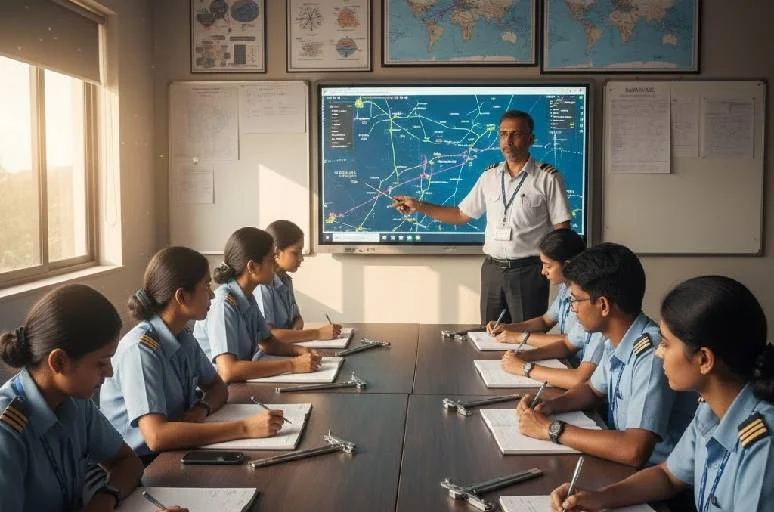
So You Want to Become a Commercial Pilot. Where Do You Even Start?
Most aspiring pilots talk endlessly about the thrill of flying — the cockpit, the clouds, the career. But very few walk into their ground training knowing what to actually expect from the DGCA exams. If you're one of those students who just Googled “DGCA CPL subjects” late at night wondering where to begin — you’re in exactly the right place.
The Commercial Pilot Licence (CPL) issued by India's Directorate General of Civil Aviation (DGCA) is your legal gateway to a professional flying career. Before you log a single flight hour toward that licence, you are required to clear a series of rigorous ground examinations that test your theoretical knowledge of aviation science, law, and aircraft systems.
These exams are not merely formalities. They exist because a commercial pilot's decisions directly affect the safety of hundreds of passengers. The better you understand these subjects, the better pilot — and the better professional — you become.
The 6 Core DGCA CPL Subjects You Must Clear
Under the CPL syllabus India framework, students must clear six theoretical subjects as part of the DGCA examination system.
- Air Navigation
- Aviation Meteorology
- Air Regulations
- Technical General
- Technical Specific
- Radio Telephony Restricted (RTR)
DGCA conducts CPL examinations four times every year. Passed subjects are valid for 5 years. Passing Criteria is 70% in each subject is required to pass.In addition to these regular exams, DGCA may conduct online on-demand exams (OLODE) for specific needs. Registration for all sessions is conducted through the DGCA Pariksha portal.
1. Air Navigation – Finding Your Way Across the Sky
What Does It Teach?
Air Navigation is the science of determining where your aircraft is, where it needs to go, and how to get there safely. The subject covers the fundamentals of the Earth's geometry, time conversions, magnetic variation, chart reading, dead reckoning navigation, radio navigation aids such as VOR, ADF, DME, ILS, and GPS, instrument navigation, flight planning, mass and balance, and aircraft performance calculations.
Why It Matters
Navigation is the backbone of flight operations. Even in the age of GPS, a commercial pilot is expected to understand the “why” behind every instrument reading and route decision.
Common Challenges Students Face
Students often struggle with triangle of velocities calculations, wind correction angles, chart interpretation, and mass-and-balance calculations under exam pressure.
Preparation Tips
- Practice navigation calculations daily
- Use navigation computers such as CRP-5
- Understand concepts before memorizing formulas
- Solve previous DGCA navigation question papers
2. Aviation Meteorology – Reading the Sky Like a Professional
What Does It Teach?
Meteorology introduces students to the science of the atmosphere and weather patterns. Topics include atmospheric pressure, humidity, air density, cloud formation, fog, turbulence, jet streams, icing, thunderstorms, monsoons, tropical cyclones, air masses, fronts, and weather reports such as METAR, TAF, and SIGMET.
Why It Matters
Weather is one of the most important factors affecting flight safety. A pilot who truly understands meteorology can anticipate hazardous weather conditions and make safer operational decisions.
Common Challenges Students Face
Students often find frontal systems, icing conditions, and upper-level wind patterns confusing at first.
Preparation Tips
- Study Indian climatology separately
- Use weather diagrams and charts
- Practice decoding real METAR and TAF reports
- Focus on conceptual understanding rather than memorizing definitions
3. Air Regulations – The Law That Governs Every Flight
What Does It Teach?
Air Regulations cover the legal and procedural framework of aviation. The syllabus includes ICAO conventions, the Indian Aircraft Act 1934, Aircraft Rules 1937, Civil Aviation Requirements (CARs), and various ICAO annexes governing aviation operations.
Why It Matters
Aviation operates under strict global regulations. Pilots must understand these rules to ensure legal compliance and safe operations within controlled airspace.
Common Challenges Students Face
Students often feel overwhelmed by the large number of regulatory definitions and rules included in the syllabus.
Preparation Tips
- Create structured notes for ICAO annexes
- Memorize key aviation definitions
- Practice DGCA regulation-based question banks
- Revise frequently
4. Technical General – Understanding the Aircraft
What Does It Teach?
Technical General explains how aircraft systems function. Topics include aerodynamics, aircraft structures, hydraulic systems, electrical systems, fuel systems, landing gear systems, pressurization, piston engines, turbine engines, and propeller operation.
Why It Matters
Pilots must understand how aircraft systems operate so they can manage abnormal situations and system failures safely during flight.
Common Challenges Students Face
Technical General is widely considered the most challenging DGCA CPL subject due to the large syllabus and engineering-based concepts involved.
Preparation Tips
- Study aircraft system diagrams carefully
- Understand aerodynamic principles clearly
- Divide the syllabus into smaller study modules
- Start preparation early
5. Technical Specific – Aircraft Type Knowledge
Technical Specific focuses on the aircraft type used during flight training. Students must understand aircraft limitations, engine operations, system procedures, and performance charts related to the specific aircraft.
Studying the aircraft Pilot Operating Handbook (POH) is essential for mastering this subject.
6. Radio Telephony Restricted (RTR)
RTR certification ensures that pilots can communicate effectively with Air Traffic Control using ICAO standard phraseology. Topics include distress communication procedures, urgency messages, ATC clearances, communication failure procedures, and standard aviation radio communication protocols.
Clear communication between pilots and air traffic controllers is critical for safe airspace operations.
Why Conceptual Understanding Is Important
DGCA examinations increasingly test conceptual understanding rather than simple memorization. Students who understand the principles behind aviation systems, navigation calculations, and weather patterns perform better in exams and in real-world flight operations.
Prepare for DGCA CPL Subjects with CPAC
Captain Preeti Aviation Classes (CPAC) provides structured ground training for all DGCA CPL subjects including Air Navigation, Aviation Meteorology, Air Regulations, Technical General, Technical Specific, and RTR preparation.
Start Your Pilot Training with CPAC
Captain Preeti Aviation Classes provides professional CPL ground training with experienced aviation instructors.
cpacpilots.com
+91 7999854151
cpacpilots@gmail.com
Frequently Asked Questions
How many subjects are there in DGCA CPL?
There are six subjects in the DGCA CPL syllabus: Air Navigation, Aviation Meteorology, Air Regulations, Technical General, Technical Specific, and Radio Telephony Restricted.
Which is the toughest DGCA CPL subject?
Many students consider Technical General the toughest subject because it covers a wide range of aircraft systems, aerodynamics, engines, and electrical systems.
How long does it take to complete DGCA CPL subjects?
Students usually have around 30 months to clear all DGCA CPL examination papers after passing the first subject.
What is the best way to prepare for DGCA CPL exams?
The most effective strategy is to focus on conceptual learning, solve previous DGCA question papers, and follow structured training with experienced aviation instructors.
